
Academic Year 2026-2027
Updated April 24, 2026
This handbook presents information relevant to a student’s graduate career in the Department of Statistics at Florida State University (FSU). A copy of the handbook is available on the department webpage. Student suggestions for changes, additions and corrections to the handbook should be submitted to the faculty through the Department of Statistics Student Advisory Committee.
Additional information relevant to graduate students is found in the following (information from these sources is not repeated here):
- The Florida State University General Bulletin
- The Florida State University General Bulletin Graduate Edition
- The Florida State University Graduate and Professional Student Handbook
- The Florida State University Department of Statistics Undergraduate Handbook
For undergraduates at the Florida State University, the Department of Statistics offers combined undergraduate/graduate B.S./M.S. degrees in Statistics, Biostatistics and Statistics with a major in Statistical Data Science (Section 4).
For graduate students the Department of Statistics offers Master of Science degrees in Biostatistics, Statistics, and Statistics with a major in Statistical Data Science. The Department of Statistics also offers Doctor of Philosophy degrees in Biostatistics and Statistics. Additionally, the Department offers graduates certification in Data Management and Analysis using SAS (Section 2).
The Florida State University Department of Statistics offers a graduate certificate in Data Management and Analysis with SAS. The certificate requires completion of four courses from the Department of Statistics and submission of an accompanying portfolio documenting substantial SAS mastery. Upon approval, the certification will appear on the student’s transcript.
Required Coursework: To earn the certificate, applicants must complete the course STA 5066 Data Management and Analysis with SAS and three additional courses. To be counted towards certification, courses must be taken for a letter grade, and a grade of at least a B- must be earned in all four courses. Some possible courses are listed in the list below. This is a non-exhaustive list; other courses may be approved by the Certificate Director.
Required Portfolio: Before the end of the semester of the last course taken for the certification, an applicant must submit to the Certificate Director a portfolio of SAS assignments or projects completed by the applicant that demonstrate SAS mastery. The portfolio must include four tabbed sections corresponding to the four courses selected toward certification. Each section must document one major assignment from the corresponding course for which the student utilized SAS tools in solution. At least one tabbed section must contain a course project illustrating an extensive application of the SAS system that demonstrates several dimensions of SAS skills deemed valuable for public sector, private sector, or graduate schoolwork. A suitable project may be selected for inclusion from any of the four courses in the program. More than four assignments/projects may be submitted, but no more than two per tabbed section is permitted. After evaluation by the Certificate Director, the portfolio will be returned to the applicant and may be a useful addition to employment applications.
Below is a nonexhaustive list of courses that may be used toward completion of requirements for the graduate certificate in SAS Programming and Data Analysis:
- STA 5067 Advanced Data Management and Analysis with SAS
- STA 5168 Statistics in Applications III
- STA 5179 Applied Survival Analysis
- STA 5198 Epidemiology for Statisticians
- STA 5206 Analysis of Variance and Design of Experiments
- STA 5207 Applied Regression Methods
- STA 5244 Clinical Trials
- STA 5197 Longitudinal Data Analysis
- STA 5666 Statistics for Quality and Productivity
- STA 5707 Applied Multivariate Analysis
- STA 5856 Time Series and Forecasting Methods
- STA 5939 Introduction to Statistical Consulting
Any course approved for department graduate students that is not required for the degree being sought may be taken for elective credit except STA 5126, STA5172, STA5206, STA5323, and STA5440. These five courses were designed for graduate students in other departments and colleges. Students who took any of these courses before being admitted to a graduate degree program in statistics may use them as electives (if the credits have not been used in a previous degree) so long as they did not earlier take a more advanced course covering a substantial amount of similar material. Students cannot count STA 5126, 5172, or 5206 for elective credit if they have earlier taken any of STA 5166, 5167, or 5198; they cannot count STA 5323 or 5440 if they have earlier taken STA 5326.
A master’s student may, with the prior approval of the graduate director, take one 3 credit course from an outside department as an elective counted toward their degree.
Doctoral students in either program (Statistics or Biostatistics) may take courses in other departments that are relevant to their research so long as they receive the permission of their major professor and the department chair.
The combined pathway BS/MS degree program in the Department of Statistics is designed for motivated and academically strong students who wish to pursue graduate work at an accelerated pace, culminating in a Bachelor of Science degree in Statistics and a Master of Science degree in either Statistics – Applied Statistics, Biostatistics, or Statistics – Statistical Data Science. Undergraduates seeking a more challenging curriculum, possessing a strong academic record, and desiring to gain advanced insights into the discipline of statistics are invited to apply for admission to this program.
4.1 Requirements for Admission
An undergraduate student wishing to enroll in this program must meet the following criteria.
- Completion of at least 12 credits of mathematics or statistics in the undergraduate statistics major at Florida State University with a GPA in the major of at least 3.2.
- Completion of at least 90 credit hours (60 for Honors students). Transfer students must have completed at least two semesters and 24 credits at FSU with minimum overall FSU GPA of a 3.0.
- Approval of the statistics undergraduate director.
4.2 Admission Process
Students who anticipate eligibility should meet with the statistics undergraduate director during their sophomore year to determine if they are qualified and devise a plan of study through their senior year. Undergraduate students may apply to the program as early as the second semester of their sophomore year but no later than the second semester of their junior year. The application may be found online on the Department of Statistics website. The application should include the required list of shared courses to be completed in the fourth year (12 credits), anticipated semester of completion for each listed course, and be signed by both the undergraduate and graduate advisors. It may be turned into the department Academic Program Specialist in the statistics main office.
After acceptance into the program and once a student is eligible to take graduate coursework, an “Undergraduate Request to Take Graduate Courses” form should be obtained from the Registrar’s office or online. Students should indicate that the “shared” courses to be taken in that semester will count toward both the BS and MS degrees by checking the appropriate boxes on the form. All graduate level courses must gain approval through this form before enrollment. The processing of this form should be started as soon as possible since it is due to the Registrar no later than the last day of drop/add of the semester the graduate course(s) will be taken.
4.3 Requirements for Retention in the Program
To remain in the accelerated program a student must maintain at least a 3.0 GPA in all course work and at least a 3.2 GPA in statistics courses at or above the 4000 level. The student must also be successfully admitted to the graduate school in their fourth year. Application to the graduate school should be done no later than the end of the student’s first semester of their senior year. Students not accepted into the graduate school may not continue with the accelerated program.
4.4 Curriculum
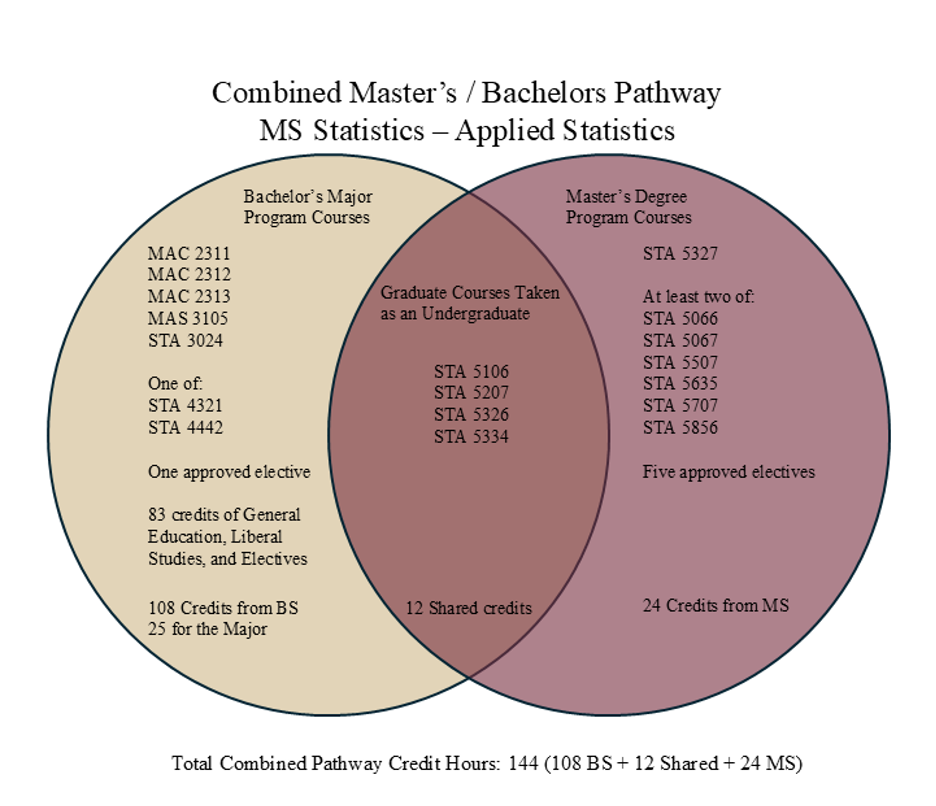
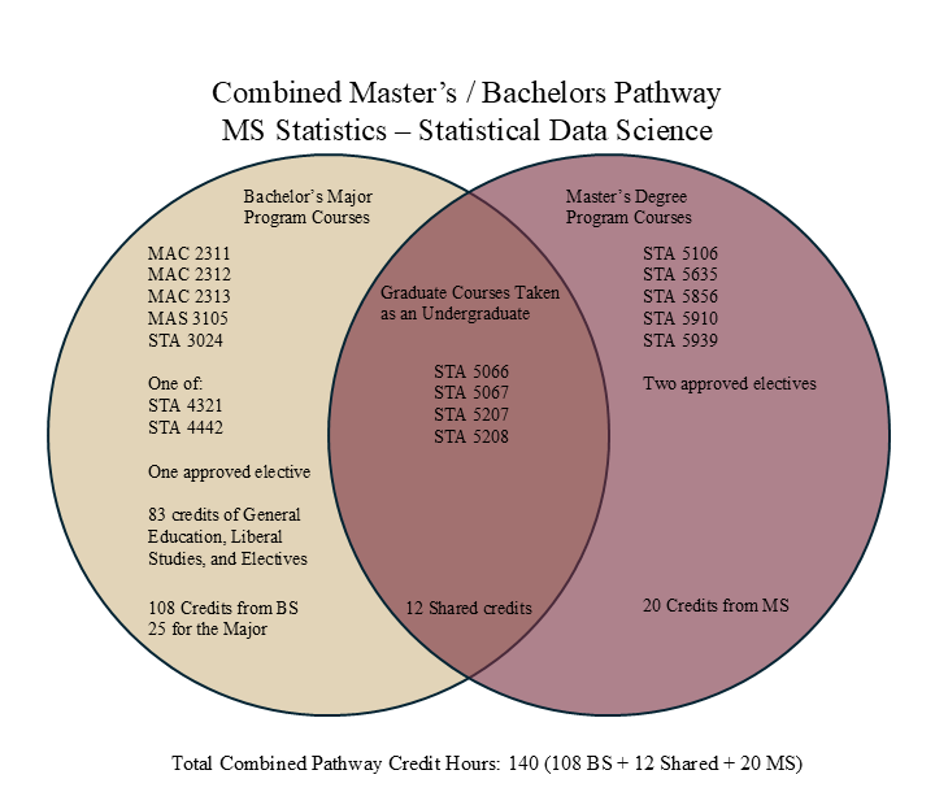
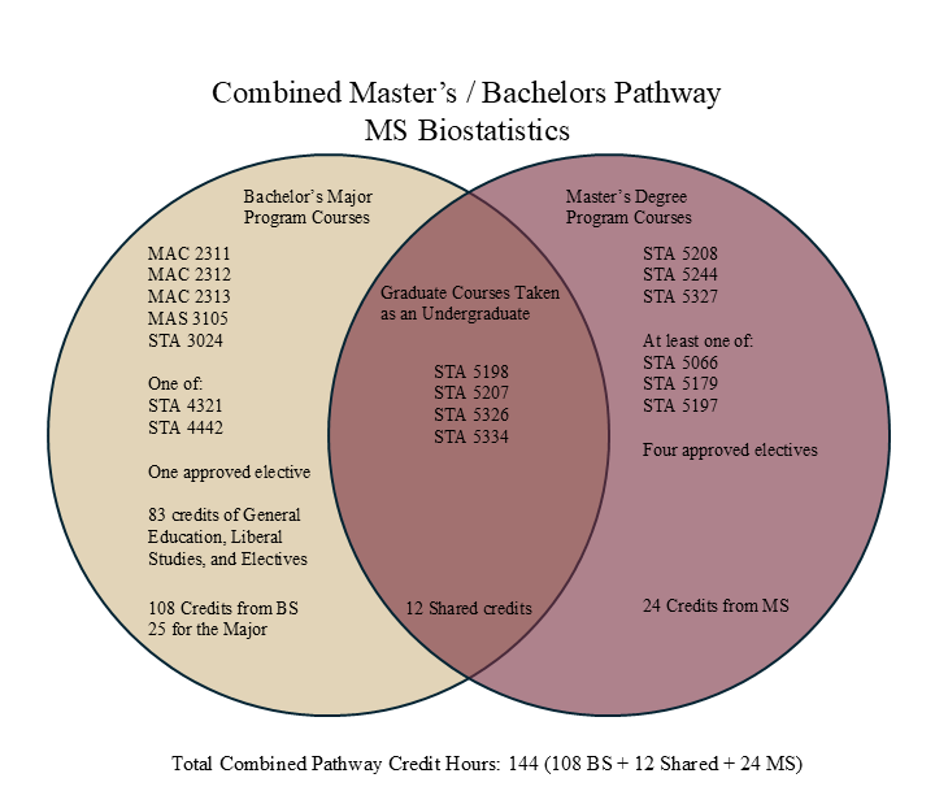
The three programs have a common core of four graduate courses to be taken as an undergraduate. The additional graduate courses then differ depending on the degree. Students must earn a B or higher in all graduate courses taken as an undergraduate in order for them to be applied toward their graduate degree. Degree requirements can be seen in the figures below.
Requirements for the BS/MS degree in Statistics – Applied Statistics
Requirements for the BS/MS degree in Statistics – Statistical Data Science
Requirements for the BS/MS degree in Biostatistics
It is possible to earn two degrees simultaneously, and many students have taken advantage of this to earn an MS in Statistics while pursuing an MS or PhD in another department. However, various university rules apply in this situation. Consult the most recent FSU Graduate Bulletin to make sure you are following the most recent rules.
The Department of Statistics at FSU offers two MS degrees in Statistics: an MS in Statistics (36 Required Credit Hours) and an MS in Statistics with major in Statistical Data Science (32 Required credit hours). The department also offers an MS degree in Biostatistics (36 Required Credit Hours). All MS degrees may be obtained through course work or a thesis option. Additionally, there are two tracks available for obtaining an MS degree in Statistics: the Applied Statistics track and the Mathematical Statistics track. There is also an MS in Data Science option. This degree is part of the Interdisciplinary Data Science program which is a different department.
The Master of Science degree in Statistics – Applied Statistics track is for a student preparing for a career as an applied statistician or as a statistical consultant at the MS level. This program emphasizes statistical computation, methodology, and consulting.
The Master of Science degree in the mathematical statistics track prepares a student for a professional career in industry or government, for a teaching career in a small college, or for further study toward the doctorate in statistics. The program emphasizes statistical theory, probability theory and mathematical analysis, as well as applied statistics. Normal entry to the program is in the fall semester. See section 6.2 below.
The Master of Science in Statistics – Statistical Data Science emphasizes hands-on training in the application of data management and statistical methods and the use of data management, computational, and analytic software geared toward producing highly employable master’s degree students. In this program, students will obtain a background in applied statistical methods, and proficiency in the software packages SAS and R to solve data management and analysis problems for the most common scenarios facing data-driven decisions in government and industry. The degree may be completed in three semesters and requires 32 credits rather than 36 credits that are necessary for the other MS degrees. A SAS certificate adds to employability and may be obtained simultaneously.
The Master of Science in biostatistics prepares graduates for employment in private, academic and public sector research and health care settings. The degree emphasizes the application of statistical principles, processes, applications, and analytic methods to design, implement, and analyze health related studies including both experimental (clinical trials) and observational (epidemiological) studies.
All the MS degrees provide a route to a career in statistics. Prospective students should note that the MS in Statistics – Mathematical Statistics and the MS in Biostatistics degrees provide the best preparation for continuation into the corresponding doctoral programs in this department. A student who finishes the MS in Statistics – Applied Statistics can apply for the PhD program upon completion of the core courses for the MS in Statistics – Mathematical Statistics or the MS in Biostatistics and passing the PhD comprehensive examination.
The total academic credits required for graduation for each of the Statistics and Biostatistics MS degrees is 36 credit hours. The MS in Statistics – Statistical Data Science requires 32 credit hours. The minimum cumulative GPA in all courses is 3.0. No more than six credit hours for the MS degrees (Statistics – Mathematical Statistics, Statistics – Applied Statistics, Biostatistics, Statistics – Statistical Data Science) may be taken S/U and all required courses must be taken for a letter grade.
For all the degrees, programs of study are developed individually in consultation between students and their academic advisors. A program of study must be completed by all students by the end of their first semester in the department, and the program should be updated annually. Each student’s program of study must be approved by the students’ academic advisor and by the department chair. If a student has already taken a course listed as required, it need not be repeated. Instead, the student should substitute a more advanced course or an alternate course. Students usually begin working toward the MS degree during the fall semester.
6.1 Master of Science in Statistics — Applied Statistics
Required courses for M.S. in Statistics — Applied Statistics
- STA 5106 Computational Methods in Statistics I
- STA 5207 Applied Regression Methods
- STA 5326 Distribution Theory and Inference
- STA 5327 Statistical Inference
- STA 5334 Limit Theory of Statistics
At least two of the following courses:
- STA 5066 Data Management and Analysis with SAS
- STA 5067 Advanced Data Management and Analysis with SAS
- STA 5507 Applied Nonparametric Statistics
- STA 5635 Applied Machine Learning
- STA 5707 Applied Multivariate Analysis
- STA 5856 Time Series and Forecasting Methods
A typical course program for the M.S. in Statistics — Applied Statistics
Year 1
Fall
- STA 5207
- STA 5326
- STA 5334
Spring
- STA 5106
- STA 5327
- Elective
Year 2
Fall
- Required
- Elective
- Elective
Spring
- Required
- Elective
- Elective
6.2 Master of Science in Statistics — Mathematical Statistics
Required courses M.S. in Statistics — Mathematical Statistics
- STA 5106 Computational Methods in Statistics
- STA 5107 Statistics in Applications I
- STA 5207 Applied Regression Methods
- STA 5208 Linear Statistical Models
- STA 5326 Distribution Theory and Inference
- STA 5327 Statistical Inference
- STA 5334 Limit Theory of Statistics
- STA 6346 Advanced Probability and Inference I
- STA 6448 Advanced Probability and Inference II
At least three of the following courses:
- STA 5507 Applied Nonparametric Statistics
- STA 5707 Applied Multivariate Analysis
- STA 5721 High-Dimensional Statistics
- STA 5856 Time Series and Forecasting Methods
- STA 6709 Spatial Statistics
A typical course program for the M.S. in Statistics — Mathematical Statistics
Year 1
Fall
- STA 5207
- STA 5326
- STA 5334
Spring
- STA 5208
- STA 5327
- STA 5106
Year 2
Fall
- STA 6346
- STA 5107
- Elective
Spring
- STA 6448
- Elective
- Elective
6.3 Master of Science in Statistics — Statistical Data Science
Required Courses
- STA 5207 Applied Regression Methods
- STA 5208 Linear Statistical Models
- STA 5066 Data Management and Analysis with SAS
- STA 5067 Advanced Data Management and Analysis with SAS
- STA 5106 Computational Methods in Statistics I
- STA 5856 Time Series and Forecasting Methods
- STA 5635 Applied Machine Learning
- STA 5910 Supervised Research: Professional Skills Seminar
- STA 5939 Introduction to Statistical Consulting (Capstone project)
Typical Course Program
Semester 1
- STA 5207
- STA 5066
- STA 5910 (2 cr)
- Elective (STA 5934)
Semester 2
- STA 5208
- STA 5067
- STA 5106
- Elective
Semester 3
- STA 5856
- STA 5939
- STA 5635
6.4 Master of Science in Biostatistics
Flexibility is allowed in selecting additional coursework for the biostatistics degree. The final selection of courses will be determined by the student and their major professor.
Required Courses
- STA 5198 Epidemiology for Statisticians
- STA 5207 Applied Regression Methods
- STA 5208 Linear Statistical Models
- STA 5244 Fundamentals of Clinical Trials
- STA 5326 Distribution Theory and Inference
- STA 5327 Statistical Inference
- STA 5334 Limit Theory of Statistics
At least one of the following courses:
- STA 5066 Data Management and Analysis with SAS
- STA 5179 Applied Survival Analysis
- STA 5197 Longitudinal Analysis
Typical Course Program
Year 1
Fall
- STA 5207
- STA 5326
- STA 5334
Spring
- STA 5208
- STA 5327
- STA 5198
Year 2
Fall
- STA 5244
- Elective
- Elective
Spring
- Elective
- Elective
- Elective
6.5 Master of Science in Statistics or Biostatistics, Thesis Option
The thesis option requires writing a thesis and an oral defense before the thesis committee. For the thesis option, the student may replace two of the elective courses with thesis hours.
A student selecting the thesis option must meet the university requirements for thesis submission. These requirements include clearance and formatting, human subjects clearance (if appropriate), and meeting the deadline for the submission of the final version of the thesis to the graduate school. For a complete list of requirements, consult the degree requirement section of the university graduate bulletin.
The Department of Statistics offers a PhD in Statistics and a PhD in Biostatistics. Course programs and exact degree requirements are determined individually for students through consultation with their supervisory committee. See the FSU Graduate Bulletin for the University’s degree requirements, requirements for residence, time limits for the degree, and minimum dissertation hours.
7.1 Requirements for All PhD Students
7.1.1 Required Courses for All PhD Students
The course, STA 5910 Supervised Research, “Faculty Research Presentations,” must be taken by all PhD students.
7.1.2 Comprehensive Examination
This written examination is required for students who wish to pursue a PhD. It is not required for students who only desire an MS. The Comprehensive Examination (CE) is based on first year courses and is offered at the beginning of fall and spring semesters each year. Fall of the student’s second academic year is the expected time for students to take the CE. The spring offering of the CE is for those students who failed the CE at the fall offering. The expectation is that prospective PhD students pass the CE at the beginning of fall semester in their second academic year. They must pass the CE before applying to be a PhD student. Failing to pass in the first two academic years will end a student’s department financial support beyond the second year.
7.1.3 Entrance to PhD Program
Prospective PhD students apply for the PhD program in the beginning of the spring semester of their second year. They will apply to a department committee consisting of the department Graduate Student Recruiting and Admissions Committee supplemented by the chair of the TA Supervision and Duty Assignments Committee and the Graduate Student Director.
The student must identify a PhD major professor as part of the application process. They may begin research under this professor through directed individual study (DIS) at any time prior to becoming a PhD candidate. They do not need to have a full PhD committee formed for the application. Pairing of a student with a major professor requires the mutual consent of both the student and the major professor.
The major professor is expected to remain with the student until one of these events occurs:
- The student graduates
- The student leaves the program
- The student and major professor agree to the student changing major professors
- The student is dismissed from the program
- Two unsatisfactory grades in their DIS or dissertation (DISS) courses
Materials considered for admission to the PhD program include:
- CE scores from all attempts
- Grades earned in required courses for PhD admission
- Grades earned in other department courses
- Student comportment
- Willingness of a GFS faculty member to begin advising the student
- TA performance (if applicable)
The committee will make one of the following decisions for each applicant:
- Admit to the PhD program and continue existing funding
- Admit to the PhD program and discontinue existing funding
- Admit to the PhD program and award department funding
- Deny admission to the PhD program
If denied admission to the PhD program the student leaves the department, generally with an MS provided the MS degree requirements have been met. If admitted to the PhD program, the student will begin working with the identified major professor through DIS courses on a potential research problem. Before the end of the third year, and before taking the Qualifying Examination (as described below), the student must form the remainder of the PhD committee in accordance with this graduate student handbook.
7.1.4 Qualifying Examination
By the end of the third year, the student must take the Qualifying Examination (QE). This exam is given by the student’s full PhD committee.
The selection of a PhD committee and chair is done by mutual agreement between the student and faculty. It is expected that each student will review faculty research areas and initiate discussions with prospective faculty to act as committee members and chair. The department chair approves all such committees.
The chair and at least two other members of the committee must be full-time tenure-track faculty from the statistics department with graduate faculty status. At least one committee member other than the chair (or co-chairs) must be a tenured faculty from the statistics department with graduate faculty status. See the FSU Graduate Bulletin for other requirements regarding forming a committee.
The student will create a manuscript detailing their current research progress and future research direction and provide this manuscript to the committee at least two weeks prior to the exam date. The student will also give a presentation of the manuscript to the committee as part of the QE.
Each committee member, other than the university representative, will submit at least one question to the student at least one week prior to the date of the exam. The questions should be relevant to the current and planned research of the student. The student will incorporate their answers to these questions in their presentation
The committee will evaluate:
- The student’s research presentation and manuscript
- The student’s research ability, progress, and potential
- The student’s performance in required coursework since being admitted to the PhD program
- The student’s performance in courses assigned by the major professor since being admitted to the PhD program
- The student's performance on committee-supplied questions relating to their presentation and manuscript. The student will provide thorough answers to these questions in writing to the committee within one week of the presentation
The committee assigns a grade of pass or fail on the QE based on the criteria in above. If the student fails the QE and wishes to continue in the program, they and the major professor must mutually decide if they will continue to work together, or if the student will find a new major professor. A student failing to pass the QE will be considered to be making unsatisfactory progress toward the degree for that semester.
If the student fails the QE and wishes to continue in the program, they must retake and pass it by the end of the fourth year. A student is allowed only two attempts at the QE. A student may not two QEs in a single semester and there must be at least 12 weeks between QE attempts. A student who has not passed the QE by the fourth year loses department support and is removed from the program.
If the student takes the QE a second time in a fall or spring term and fails, their funding ends at the end of spring of that academic year and they are removed from the program at the end of spring of that academic year. If the student takes the QE a second time in a summer term and fails, their funding ends at the end of that summer term and they are removed from the program at the end of that summer term.
When a student passes the QE, they become a PhD candidate. It is then expected that the major professor remain with the student through the end of their studies unless there is documented evidence of the student’s failure to progress, if the student and major professor agree to the student changing major professors, or if the student leaves the program.
A student passing the QE in fall / spring / summer may not defend their dissertation until the following fall / spring / summer or later.
7.1.5 Dissertation Defense
The dissertation defense is the last department examination for a PhD candidate. The defense consists of a 40 – 50 minute oral presentation of the student’s dissertation open to the entire Department of Statistics. All members of the university’s graduate faculty are invited to attend the seminar. This public presentation is immediately followed by an oral, closed-door defense of the dissertation and is administered by the student’s supervisory committee.
Academic courtesy requires that the dissertation be submitted to each member of the supervisory committee and to the department chair at least four weeks prior to the date of the oral examination. Individual committee members may have their own requirements or policies regarding timing and it is the student’s responsibility to ensure that each committee member’s requirements are met and that each member has an adequate opportunity to read the dissertation. A copy of the dissertation should also be sent to the department academic assistant at least four weeks prior to the defense. Faculty interested in the topic may obtain a copy of the dissertation from the department academic assistant before the defense.
The defense must be completed at least four weeks prior to the date on which the degree is to be conferred. Consult the registrar’s office or webpage for deadline dates. Students must enroll in STA 8985 during the term in which they defend their dissertation.
A decision of pass for the defense of dissertation requires at least a majority approval of the entire committee as well as at least a majority approval of the full-time statistics department committee members. Majority is defined as more than one half. See the FSU Graduate Bulletin for other information regarding dissertation grades.
7.2 Other Requirements
During the final semester of doctoral work, each PhD candidate must comply with a variety of university administrative requirements prior to obtaining the degree. The university also has specific requirements regarding the format for dissertations and abstracts. These requirements are issued by the Graduate School. Each candidate should become familiar with these requirements well in advance of their final semester’s work.
All PhD students must take the department courses required for their degree, either the PhD in Statistics or the PhD in Biostatistics.
PhD students must take at least one course each semester for the first three years of study. Beyond the third year and after the departments required coursework has been completed, additional course work other than dissertation research will be determined by the student with the approval of their major professor and their dissertation committee.
All required coursework (as provided in the list of required courses for the degree being sought) except dissertation hours must be taken for a letter grade.
PhD students must demonstrate active involvement in the scholarly community through interaction with faculty and peers. This requirement may be met through participating in various scholarly activities including enrollment in courses, attendance at colloquium, utilization of the library, utilization of university computational facilities, engaging in collaborative study and research beyond the university campus, and attendance and presentations at professional conferences. Note: It is the students’ responsibility to document this involvement every year as part of their annual review.
Graduate students at Florida State University must maintain continuous enrollment, which is defined as enrollment without an interruption of two or more consecutive semesters (where summer term counts as a semester!). Graduate students who are not enrolled at the University for two or more consecutive semesters, and who are not on approved leave of absence, must apply for readmission before resuming their studies. (For example, if you are not enrolled for a spring semester and the following summer term, then you must apply for readmission unless you have an approved leave of absence.)
A student who has completed the required coursework, passed the PhD Qualifying Examination, and advanced to doctoral candidacy, and continues to use campus facilities and/or receives faculty supervision, but has not been cleared by the Manuscript Clearance office shall include in the required full-time load a minimum of two credit hours of dissertation per semester, including Summer term, until completion of the degree. A student must be enrolled in a minimum of two hours of dissertation in the semester of graduation. Prior to degree conferral, all doctoral students must have completed a minimum of twenty-four credit hours of dissertation.
Note that the university rules in the previous two paragraphs allow a graduate student who is working on their dissertation to take a semester or a summer off without signing up for any dissertation units so long as they are not using campus facilities or receiving faculty supervision during this time.
7.3 Graduation Requirements
In their final semester, students must apply for degree clearance in the first two weeks of the term. Clearance is contingent upon successful completion of your program of study, as filed with the department. Therefore, the program should at all times accurately reflect the coursework taken. The student will be required to account for any discrepancies.
Students not enrolled in the PhD program who plan to continue working towards a PhD degree after earning a master’s degree must contact the academic program specialist in the department to discuss moving into the PhD program. Students already admitted into the PhD program but who would like to apply for the master’s degree must also contact the academic program specialist in the department to have the degree program added to their record.
There are many graduation requirements set by the university. Consult the FSU Graduate Bulletin for a comprehensive list.
7.4 Course Transfers and Waivers
The department follows the university’s criteria for allowing transfer credits.
For those wishing to use courses from another university to meet the department’s courses requirement, the student must obtain approval of the waiver from the instructor in our department who teaches the required course and the graduate director.
A form for applying for the waiver may be obtained on the department website.
It must be kept in mind that waiving a course does not grant you any credit hours; when you waive a required course, you must take another course to replace it in order to satisfy the credit hour requirements.
7.5 PhD Degree in Statistics
Students in the PhD in Statistics degree program tailor their academic programs to be consistent with their individual career objectives. Programs can be designed to prepare graduates for careers in research and/or teaching, for careers emphasizing the application of statistics or for careers requiring the development of new statistical methodology. Required courses for all students seeking the PhD in Statistics are given below in the list in section 7.6.
The department requires a minimum of 36 credit hours of coursework for the PhD in Statistics. All required courses must be taken for a letter grade, but up to 6 credit hours of other coursework can be taken S/U.
Students entering the program with equivalent work (as determined by the faculty) from other institutions will not be required to repeat it. However, in preparing a course program, students should keep in mind that they are required to pass the PhD qualifying examination as one step towards the degree.
Students entering the graduate program without any prior graduate work in statistics typically begin course work by studying toward the MS degree in mathematical statistics. Students are responsible for the material normally covered in the core course work of the MS in mathematical statistics degree.
Students are strongly encouraged to register for STA 6468, Advanced Topics in Probability and Statistics, whenever topics to be covered are related to the student’s areas of concentration. The final selection of courses will be determined by the student and major professor and supervisory committee.
7.6 PhD Degree in Biostatistics
The Doctor of Philosophy Degree in Biostatistics prepares students for specialized careers in academia, industry, and government. Program graduates will find themselves sought after by employers in such varied areas as biotechnology, public health, pharmaceuticals, AIDS research, epidemiology, insurance, food sciences, and agribusiness. With an aging US population, the development of new drugs, and advances in the understanding of biological functions at the level of individual genes and proteins, the need for more people trained to design studies and analyze data from these research areas continues to increase. Required courses for the PhD in Biostatistics are presented below.
Required courses for the PhD in Biostatistics. All courses are 3 credit hours:
- STA 5179 Applied Survival Analysis
- STA 5197 Longitudinal Data Analysis
- STA 5198 Epidemiology for Statisticians
- STA 5207 Applied Regression Methods
- STA 5208 Linear Statistical Models
- STA 5244 Fundamentals of Clinical Trials
- STA 5326 Distribution Theory
- STA 5327 Statistical Inference
- STA 5334 Limit Theory of Statistics
- STA 6346 Advanced Probability and Inference I
- STA 6448 Advanced Probability and Inference II
The department requires a minimum of 36 credit hours of coursework for the PhD in Biostatistics. All required courses must be taken for a letter grade, but up to 6 credit hours of other coursework can be taken S/U. Flexibility is allowed in selecting the additional coursework for the Biostatistics PhD. The final selection of courses will be determined by the student and major professor and supervisory committee.
The department provides financial support for many of its graduate students. The two main ways in which students are funded are through teaching assistantships and research assistantships.
8.1 Types of Support
Teaching assistantships are the most common type of support in the department. These are half-time appointments. Students are paid a salary in return for 20 hours of work each week during the fall and spring semesters. Limited teaching assistantships are available each summer. Teaching assistants may be called upon to perform a combination of the following duties:
- Lecture in lower division statistics courses (STA 1XXX, 2XXX).
- Teach recitation sections of low-level statistics courses.
- Grade homework, projects, and exams for lower and upper level undergraduate and graduate level courses.
- Assist faculty with course-related tasks.
- Assist faculty in the Statistical Consulting Center.
Assignment of graduate students to differing duties is based on department need and when possible, student preference. Please note that all TA assignments are based on departmental need, departmental budget, your TA qualifications, your academic progress, your prior performance as a TA, etc.
There are several university requirements that must be met before a graduate student may teach. These requirements are set forth in the document, University-wide Standards for Teaching Assistants at Florida State University. This document is maintained by and available from the Office of Graduate Studies. Additionally, a TA must pass the departmental course “Teaching in the Discipline” before teaching. Graduate instructors are observed in the physical or Zoom classroom once a year. Lecture videos are reviewed for those who teach online asynchronous
Research assistantships are supported with funds from research contracts or grants, generally from agencies outside the university, held by department faculty. Students receiving such support assist faculty members with their research programs. Usually a student combines duties under this assistantship with their dissertation work, but the exact duties are established by the faculty member providing support.
In recognition of the differing degrees of responsibility of the above tasks, the amount of stipend provided to a student depends on the duties assigned. There are three levels of stipend in the department. The highest level of stipend is for those who solo-teach 4-hour classes. The middle level is for those who solo-teach 3-hour classes. The lowest level is for graders, online mentors and recitation TAs. Research assistant pay is determined by the faculty member supplying the salary.
Other avenues of support include competitive assistantships and fellowships available through the university. More general types of support include loans and grants and are administered through the university’s Office of Student Financial Aid. Additionally, opportunities for employment in other university units are often available.
8.2 Restrictions on Support
Recipients of federal fellowships or traineeships or university fellowships must abide by the conditions of these awards. International graduate students must observe employment restrictions associated with visas issued.
Holders of assistantships are required to register for at least nine hours each semester. Students are advised to consult the FSU Graduate Bulletin for the university policy regarding minimum enrollment require- ments for assistantship holders and university residence requirements. Note that students not receiving support must also register for a minimum number of hours each term to meet university requirements.
The department expects all domestic students to apply for the in-state residency tuition classification.
8.3 Requirements for Continued Department Support
Students receiving department financial support must complete the following to continue to receive it:
- Master’s degree students who have not been accepted for continuing to the PhD degree will not receive financial support beyond their second year.
- To be eligible to receive department financial support as a teaching assistant, PhD students must:
- Complete modules 1, 2, & 3 of the Essential Policies & Practices Training for TAs offered by FSU CAT
- Complete the Teaching-in-the Discipline training workshop in the first year.
- Pass the PhD written qualifying exam by January of their third academic year.
- Students whose primary language is not English must take and pass the FSU SPEAK exam with a score at least 50 by the end of the spring semester of their second academic year.
- Financial support as a TA stops at the end of the fifth academic year.
- For PhD students who have passed their qualifying exam, their financial support will be terminated if they receive two “Unsatisfactory” grades from their advisor in their dissertation study.
Students who do not meet these milestones may continue toward their degree, but with no department financial support.
The department chair makes the final decision on matters of continued support.
8.4 Tutoring for Payment
The Department receives numerous requests for tutors in statistics. Graduate students in statistics may tutor for payment subject to the following policies and procedures:
Under no circumstances is anyone to tutor, for payment, a student taking a course he or she is teaching or assisting with. For example, a graduate student currently teaching STA 2023 may NOT tutor any student currently taking STA 2023, even if that student is in another section. The graduate student may tutor, however, a student in STA 2122.
Students may engage in tutoring only insofar that it does not detract from their graduate studies. Students on academic probation are not to tutor. Questions regarding these policies may be addressed to the chair.
Students wishing to tutor are requested to submit the following information to the department secretary: a list of courses they wish to tutor and where or how they can be contacted. The department will maintain a file on tutors giving the above information. When requests are received, the caller will be given the information in the tutor file. The department does not make recommendations.
Please remember that tutoring is suggested as a last resort for students having difficulties in their course work. All graduate student instructors in the department are expected to make sufficient time available for office hours for student help.
In rare cases, it may be necessary to dismiss a student from the program. For graduate students in the Department of Statistics, the receipt of two unsatisfactory annual reviews is automatically considered a case in which remediation is required. In these cases, the academic advisor and the chair will determine a remediation plan that will be discussed with the student.
The remediation plan will follow the following protocol:
- Once notified of need for remediation, the graduate student meets with his or her advisor to develop a remediation plan for the completion of their degree requirements or behavioral objectives.
- The chair on advice from the advisor provides a written warning to the student that includes the remediation plan and a time frame for accomplishing the remediation. The Dean of the College of Arts and Sciences is provided a copy of this warning letter.
- If the graduate student fails to correct the specified and documented deficiencies, and on receipt of a third unsatisfactory annual review, the department will initiate a program termination. In this case, the student will receive a letter documenting the reasons for termination, the method to appeal the decision as well as the latest date for an appeal.
For dismissal of a graduate student for reasons other than GPA, see section 12.
The Department of Statistics, through the Student Advisory Committee (SAC), participates in the university-wide program which promotes active involvement of students in academic decision-making. The SAC consists of one representative each from the first- and second-year classes, two advanced representatives, and two officers.
The main function of the committee is to act as a liaison between faculty and students. By making themselves available for comments from both groups, the committee promotes effective communication and student awareness of department policies. A member of the SAC attends department faculty meetings. Some past inputs from SAC to the faculty have been to request new courses and invite specific guest speakers to department colloquia.
In addition, the SAC sponsors social/recreational events and enters teams in various intramural programs available on campus.
SAC members are elected each spring term by the graduate students. A member of the incoming class is chosen to be the SAC representative with their term beginning in the following fall term.
The department colloquium is a lecture-discussion series on research and applications in topics of interest to members of the department. Colloquia are presented by faculty members, graduate students, and visitors to the department. Attendance at colloquium is expected of all faculty and graduate students in the department, and this is part of the annual evaluation for PhD students. Suggestions for colloquium presentations are always welcomed and should be passed to the faculty though the SAC.
The department has an annual speaker competition for graduate students, the Anna and Yongyuan Li presentation award. The student who is judged by the faculty of the awards committee to have made the best presentation for the academic year is given the award.
The University reserves the right to dismiss graduate students and terminate their enrollment in an academic program based on a number of different criteria, beyond that of GPA alone. Oversight is provided by The Graduate School, Office of Faculty Development and Advancement, and Office of the Registrar. Additional details on the steps involved in the process are available for faculty and administrators from the Office of Faculty Development and Advancement and for graduate students at the Graduate School.
Dismissed students will not be permitted to register for further graduate study, including registering as non-degree students, in the degree program or college from which they had enrollment terminated. Graduate students who have been dismissed from one degree program may seek admission to another degree program but will not be readmitted or allowed to add the dismissed degree program back as a second major or degree. This includes seeking admission into a different degree program that shares a joint pathway with the dismissed degree program.
Program terminations (dismissal for a reason other than GPA) are generally identified by the faculty with support from the Department Chair (or unit head) in the department/unit or single-unit college level and may occur for a number of different reasons.